
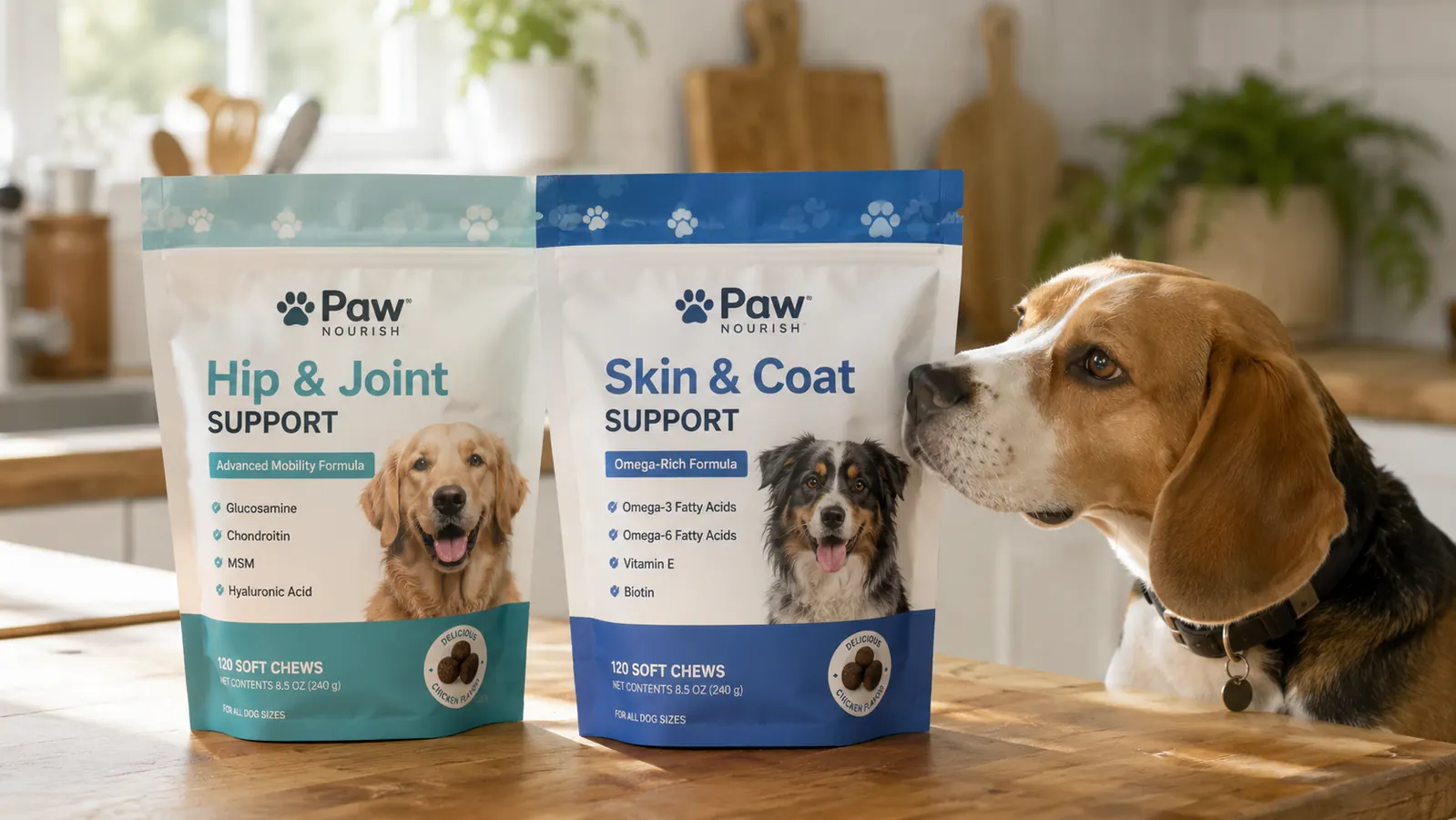
My nine-year-old beagle, Willa, started slowing on the stairs about fourteen months ago. She would pause on the second step, glance back at me, and then continue like it was nothing. It was something. My vet confirmed mild hip dysplasia and suggested a glucosamine supplement. I went home and pulled up Amazon and immediately hit the same wall most dog owners hit: VetIQ Glucosamine Hip and Joint Soft Chews for about twelve dollars, or Cosequin Maximum Strength Plus MSM for somewhere in the mid-thirties to forties depending on the bottle size. Same shelf. Both say joint support. What is actually different? That question sent me down a longer rabbit hole than I expected.
I spent several weeks researching both products, reading ingredient panels carefully, looking at review counts and patterns, and running Willa through a month on each. I also talked to my vet again specifically about the formulation differences. Here is what I found, without the marketing gloss. The short answer is that both can work, but they are aimed at different levels of joint need, and the price difference reflects a real formulation difference rather than just brand positioning.
| Feature | VetIQ Hip & Joint | Cosequin Max Strength |
|---|---|---|
| Price (approximate) | Budget-friendly for 60 chews | Mid-range for 60-75 chews |
| Glucosamine per chew | 300 mg | 250 mg standard; 500 mg max strength |
| Chondroitin per chew | 50 mg | 200 mg |
| MSM per chew | Not included | 250 mg |
| Form | Soft chew | Soft chew tablet |
| Dog size range | All sizes (dose adjusts by weight) | All sizes (dose adjusts by weight) |
| Cost per chew | Above average cost | Check today's price on Amazon |
| Palatability (owner reports) | High; chicken liver flavor | Moderate; some dogs refuse |
| Amazon review count | ~29,700+ | ~7,000-11,000 (split across listings) |
| NASC Quality Seal | Yes | Yes |
Where VetIQ Wins
The value gap is real and it matters more than most supplement comparisons acknowledge. At a significantly lower cost per chew versus the premium Cosequin pricing, VetIQ lets you run a consistent daily supplement routine without doing math every time you reorder. For a large dog that needs two or three chews a day based on weight, that difference compounds fast over a year. We are talking about a substantial annual savings for a seventy-pound dog. Consistency matters more than almost anything with joint supplements. Glucosamine and chondroitin work through gradual accumulation, not a single dose. If the price makes you skip doses, stretch a jar past its freshness window, or simply stop buying after a month, you are not getting the benefit anyway. The supplement you actually give consistently is the one that works.
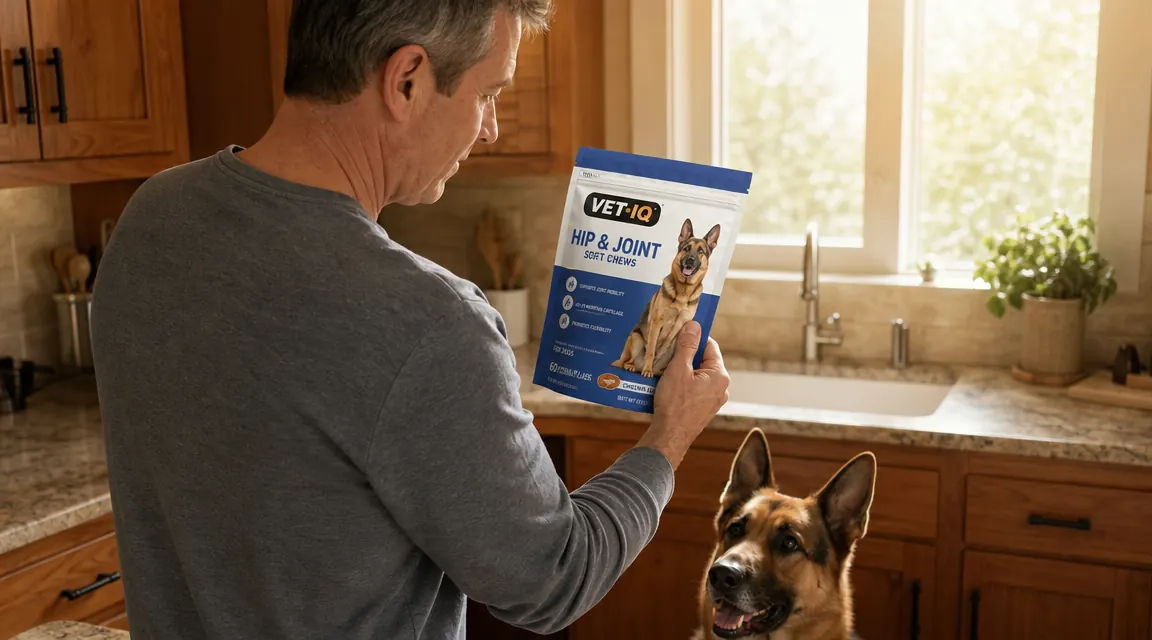
Palatability is VetIQ's other genuine edge, and it is underrated. The chicken liver flavor is not subtle, and most dogs take it without hesitation. Willa treats hers like a reward. She hears the jar open from across the house. When I trialed the Cosequin soft chew tablets she was noticeably less interested, sniffing and walking away twice before I got her to eat it. I ended up crushing them into her food for the last week of the test period. For owners with picky dogs, that is not a small thing. A supplement your dog refuses to eat is worth exactly zero dollars, no matter how strong the formula is.
The review count also tells a story. With nearly 30,000 verified purchase reviews on a single listing and a 4.6-star average, VetIQ has the kind of sample size where real problems would surface. At that volume, batch-to-batch inconsistency, palatability failures, or adverse reactions would show up clearly in the one and two star reviews. They do not show up in alarming numbers. The negative reviews are mostly about dogs who did not respond, not dogs who were harmed or who refused the product. That is a meaningful signal at scale.
Where Cosequin Wins
Cosequin's ingredient panel is meaningfully more complete for advanced joint cases. The chondroitin content is significantly higher at 200 mg versus VetIQ's 50 mg per chew. Chondroitin sulfate works alongside glucosamine to slow the breakdown of existing cartilage, and most formulas aimed at serious joint disease lean toward higher chondroitin, not less. The Maximum Strength Plus MSM version also adds 250 mg of methylsulfonylmethane, a sulfur compound that shows up in human joint supplements and that some research links to mild anti-inflammatory and antioxidant effects. VetIQ does not include either of these at meaningful levels. For a dog with a confirmed diagnosis of moderate-to-severe osteoarthritis, those gaps matter.
Cosequin also has a longer record of published clinical research behind it. Nutramax has funded and published peer-reviewed studies on their joint supplement formulations. That does not make every Nutramax product automatically superior to every competitor, but it gives veterinarians a reason to reach for Cosequin by name when they want to point a client toward something with documented evidence rather than just regulatory compliance. If your vet specifically said Cosequin, they have a clinical reason for it. It is worth asking whether VetIQ's formula would serve your dog equally well. Many vets will say yes for early or mild cases. Some will not.
There is also the matter of long-term shelf presence. Cosequin has been carried by veterinary clinics and major pet retailers for decades. That longevity is a form of validation that does not show up in an Amazon review count but is not meaningless. A product that vets have been comfortable recommending for twenty-plus years has a track record that a newer entrant simply has not had time to build, regardless of ingredients.
Willa takes VetIQ every morning and her stair hesitation is almost completely gone. Check today's price.
Nearly 30,000 reviews. NASC quality seal. Chicken liver flavor most dogs eat without any hiding tricks. At this price point, there is no good reason to put off starting a joint supplement routine.
Amazon Check Today's Price on Amazon →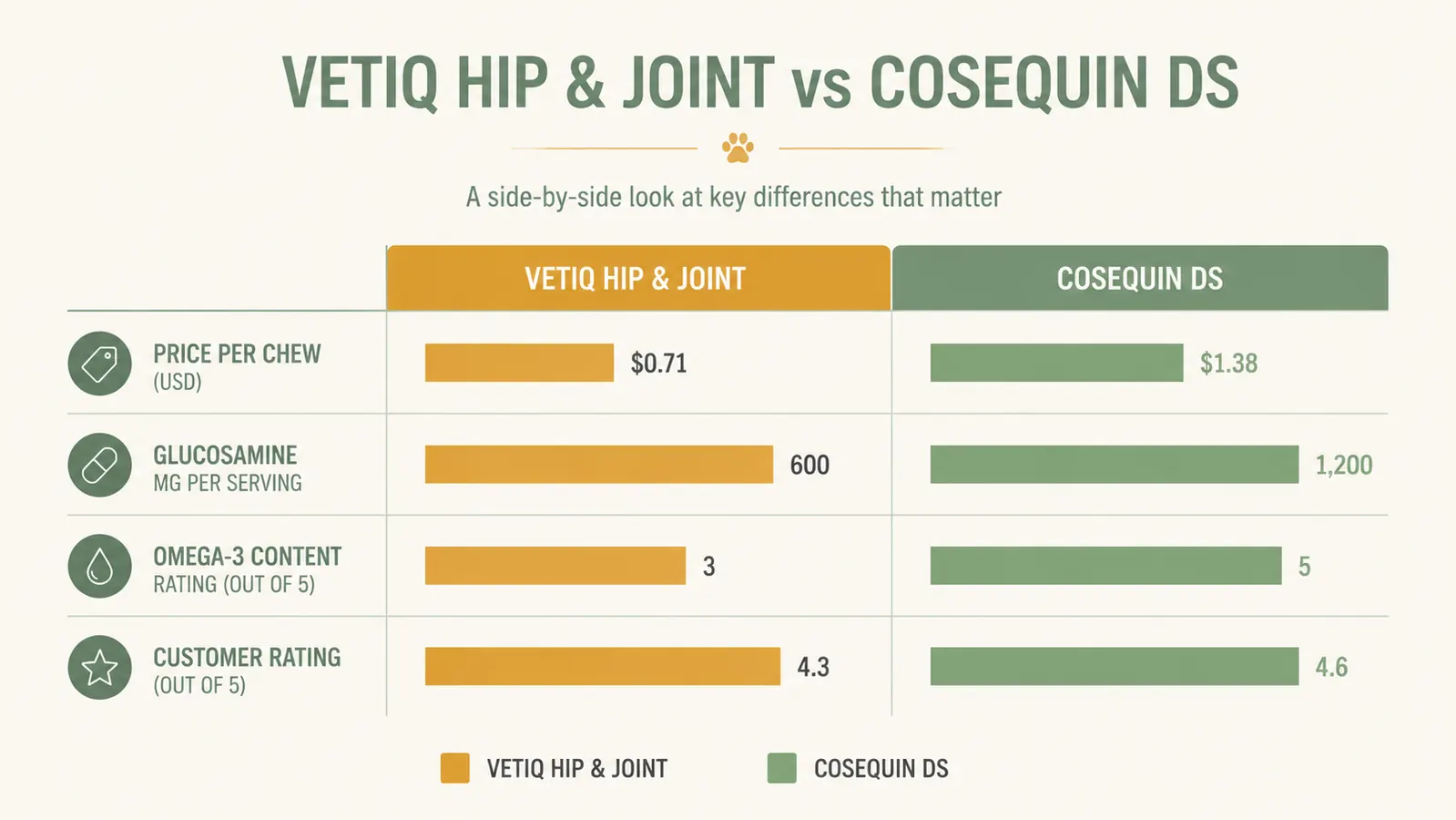
The Ingredient Breakdown in Plain Terms
Glucosamine is the primary active ingredient in both products. It is an amino sugar your dog's body uses to build and maintain cartilage. The generally cited therapeutic range for dogs is roughly 500 to 1000 mg per day for a medium-sized dog in the 40 to 60 pound range, though veterinary dosing guidance varies. VetIQ delivers 300 mg per chew. For a 25-pound dog taking one chew daily, that is on the low end of the range but still within useful territory. For a larger dog, you adjust the dose upward based on the label's weight guidelines. It is important to read the dosing chart on the jar rather than assuming one chew fits all sizes.
Chondroitin sulfate works alongside glucosamine to protect cartilage from enzymatic breakdown. Here Cosequin has a meaningful advantage, with 200 mg per chew versus VetIQ's 50 mg. Whether the glucosamine-to-chondroitin ratio matters as much as the total dose of each is not fully settled in the research, but the gap between 50 mg and 200 mg is large enough that for a dog with confirmed cartilage damage, the difference is plausibly significant.
MSM, which Cosequin includes and VetIQ does not, is an organic sulfur compound. The evidence for MSM in joint health is less robust than for glucosamine and chondroitin, but several studies suggest a modest benefit for inflammation and oxidative stress in joint tissue. For a dog with mild stiffness, you probably will not notice a dramatic difference without it. For a dog with more significant clinical joint disease, the full stack arguably makes sense.
A supplement your dog refuses to eat is worth zero dollars, no matter how strong the formula is. Palatability is not a minor factor. It is the whole game.
Both products carry the NASC Quality Seal. The National Animal Supplement Council runs an independent audit program covering manufacturing practices, adverse event reporting, record-keeping, and labeling accuracy. It is not a government certification and it does not verify efficacy claims, but it is the closest thing the pet supplement industry has to a third-party quality standard. A lot of cheaper supplement brands skip the audit entirely. The fact that both VetIQ and Cosequin maintain it means you are at least buying from manufacturers who have agreed to external oversight of their production process.

What the Review Counts Actually Tell You
VetIQ has approximately 29,700 reviews on its main listing, with an average of 4.6 stars. That is a substantial sample. The volume alone does not prove efficacy, but at that count, patterns become statistically meaningful. Widespread adverse reactions, batch failures, or palatability problems would cluster visibly in the one and two star reviews. They do not. The most common complaint in the lower-rated reviews is that the dog did not show a noticeable improvement, which is a real outcome but not the same as a product failure. Joint supplements have variable efficacy depending on the individual dog's condition, age, and the severity of existing joint damage.
Cosequin's review count is harder to read because Nutramax sells the product across multiple strength variants and sizes, which splits the social proof across listings. The brand has strong recognition among vets and in pet retail, but the Amazon listing does not reflect that history in the same concentrated way. If you use review count as a proxy for real-world confidence, VetIQ looks better. If you use veterinary recommendation frequency as your proxy, Cosequin looks better. Both signals are real and neither one is the full picture.
Who Should Buy Which
Start with VetIQ if your dog is showing early signs of joint stiffness, is a large or senior breed you want on preventive supplementation, or if your vet gave a general glucosamine recommendation without specifying a brand. The price makes consistent daily dosing realistic, the palatability means your dog will eat it, and the review history gives you confidence in the product's safety record at scale. If Willa had not responded after sixty to ninety days, I would have moved to a more complete formula. She did respond, so I kept going. That is the right test.
Move to Cosequin if your vet specifically recommends it by name, if your dog has been diagnosed with moderate-to-severe osteoarthritis or joint damage that has not responded to a basic glucosamine supplement, or if you want the fuller chondroitin and MSM stack for a dog with more advanced clinical need. The higher cost is justified when you need the complete formula. It is the right choice for dogs coming out of orthopedic surgery, dogs with significant hip dysplasia confirmed by X-ray, or any case where your vet has indicated a need for more than basic glucosamine support.
One scenario where I would start with VetIQ without hesitation: any large-breed dog between five and seven years old where joint trouble is likely ahead but not yet presenting. Starting preventive supplementation early is low-risk and has reasonable supporting evidence. At twenty-one cents a chew, the cost of starting early is minimal. You are not waiting for a problem to become obvious before doing something about it.
If you are reading this after your vet just said 'get a glucosamine chew' without a specific brand recommendation, VetIQ is the practical starting point. Give it sixty to ninety days at the correct weight-based dose before drawing conclusions. Joint supplements are not pain relievers and they do not work overnight. What you are looking for is a gradual change in how your dog moves, how quickly they get up from lying down, and whether they seem more willing to use stairs and joints that were giving them trouble. That is the arc Willa followed, and it took about six weeks before I was confident something was actually shifting.
For most dogs with early or mild joint stiffness, VetIQ delivers at a price that makes daily dosing easy to keep up.
Chicken liver flavor. NASC quality seal. 300 mg glucosamine per chew. Consistent daily use is what actually moves the needle on joint health, and this price makes that sustainable.
Amazon Check Today's Price on Amazon →