

My beagle Huckleberry turned nine last January. He weighs 28 pounds, has the appetite of a dog half his age, and has been showing signs of hip stiffness since around his eighth birthday. He started hesitating at the bottom of the stairs, doing a slow two-step shuffle when he got up from his bed in the morning, and dropping out of our evening walk about ten minutes before he used to. My vet flagged it as early hip and joint degeneration. Nothing severe, but worth managing now before it compounds into something harder to treat.
She mentioned glucosamine and chondroitin. She did not hand me a specific brand. Half the pet parents in that waiting room have probably heard the same thing and then gone home and spent an hour staring at a wall of joint supplements online. I tried two other products before landing on VetIQ Glucosamine Hip and Joint Soft Chews. I have been giving Huckleberry two to three chews a day since early March. This is what actually happened.
The Quick Verdict
A legitimate budget-tier joint supplement with real active ingredients and enough glucosamine to move the needle on mild stiffness, but the chondroitin dose does not hit vet-recommended therapeutic levels for larger dogs, and the liver smell will clear a kitchen.
Amazon Check Today's Price →If your dog is slowing down on stairs or stiff after rest, this is the supplement I kept refilling.
VetIQ Hip and Joint Soft Chews run well under most competitor products for the same core active ingredients. Worth checking the current price before you pay more elsewhere.
Amazon Check Today's Price on Amazon →How I Used It and What I Tracked
The label says two chews daily for dogs under 25 pounds, three for 26 to 50 pounds. Huckleberry is at 28 pounds, so technically he falls in the three-chew range. I started him at two chews and bumped to three at week six when I was not seeing much change. I kept a short log on my phone, nothing scientific, just a 1-to-10 note on how fast he got up from his bed in the morning, whether he hesitated on the stairs, and how far into our walk he stayed engaged before slowing down and starting to lag behind me.
The chews are small, roughly the size of a fat gummy bear, and smell aggressively of liver. Huckleberry ate them immediately every single time. My partner, who is more smell-sensitive than I am, asked me to stop keeping the bag on the kitchen counter after the first week. The resealable strip on the bag is also not strong enough to contain the odor, so I moved everything into a small plastic clip-lid container. That solved it.
I did not change his food, exercise routine, or sleeping surface during the three months. He eats Purina Pro Plan Adult kibble, sleeps on a three-inch foam orthopedic bed in the bedroom, and we do a 25-to-30-minute walk every evening. I wanted one variable so I could actually attribute changes to the supplement rather than some combination of factors.

What Is Actually in Each Chew
Each chew in the VetIQ formula delivers 250mg of glucosamine hydrochloride, 20mg of chondroitin sulfate, and 20mg of methylsulfonylmethane, which is MSM. At the two-chew serving that is 500mg glucosamine, 40mg chondroitin, and 40mg MSM per day. At three chews it comes to 750mg glucosamine, 60mg chondroitin, and 60mg MSM.
Here is the honest context on those numbers. Most veterinary guidance on glucosamine for dogs lands around 500mg to 1000mg per day for a dog under 30 pounds, so VetIQ's two-chew serving sits at the low end and the three-chew serving lands in the middle of that range. The chondroitin dose is noticeably light at any serving size. Products positioned as therapeutic joint supplements often carry 400mg of chondroitin or more per serving. VetIQ reads more like a daily maintenance supplement than a high-dose intervention product. That distinction matters depending on where your dog is on the spectrum from mild early stiffness to moderate diagnosed joint disease.
The formula also includes Vitamins C and E as antioxidants. Nothing harmful, and some evidence suggests antioxidant support may reduce joint inflammation over time, though the doses here are modest. The carrier ingredients are standard soft-chew binders: brewers yeast, tapioca starch, soy lecithin. No artificial colors. If your dog has a documented soy allergy, take note of the lecithin. Soy lecithin is a highly processed derivative and most soy-sensitive dogs tolerate it without issue, but if your dog reacts to soy in any form, confirm with your vet before starting.
What Changed Across Three Months
Weeks one through three: nothing I could document with confidence. I was watching for changes, which made me think I was imagining small improvements on the days Huckleberry seemed a little looser. I had to remind myself that glucosamine is not a painkiller and does not flip a switch in 48 hours. It provides substrate for cartilage maintenance and repair over time. The window before you see real results is measured in weeks, not days, and the studies that show benefit typically run eight to twelve weeks.
Week five was when I noticed the first consistent change. Huckleberry started getting up from his orthopedic bed without the slow shuffle almost every morning. Not every morning, maybe six out of seven, but that was a real shift from the four out of seven I had been logging. The stair hesitation went from every single descent to roughly half the time. He was still moving carefully, but the dramatic pause at the bottom of the staircase stopped being a full routine.
By week ten, his evening walks were clearly more engaged. He was pulling again on the final half-block stretch, which had not happened in several months. My partner noticed it first and mentioned it unprompted. That is the kind of external confirmation I need to separate real improvement from wishful thinking.
By week ten Huckleberry was pulling again on the last stretch of our walk. My partner noticed it first, without me saying anything.
What did not change: he still moves more slowly in the morning than in the afternoon, which is consistent with joint stiffness that loosens up with activity and warmth. He still hesitates occasionally on stairs after resting for more than an hour. These are not failures of the supplement. They reflect the underlying condition and the limits of what a maintenance-level chew can do. Joint supplements reduce the rate of degeneration and improve comfort at the margins. They do not reverse structural changes that are already present.
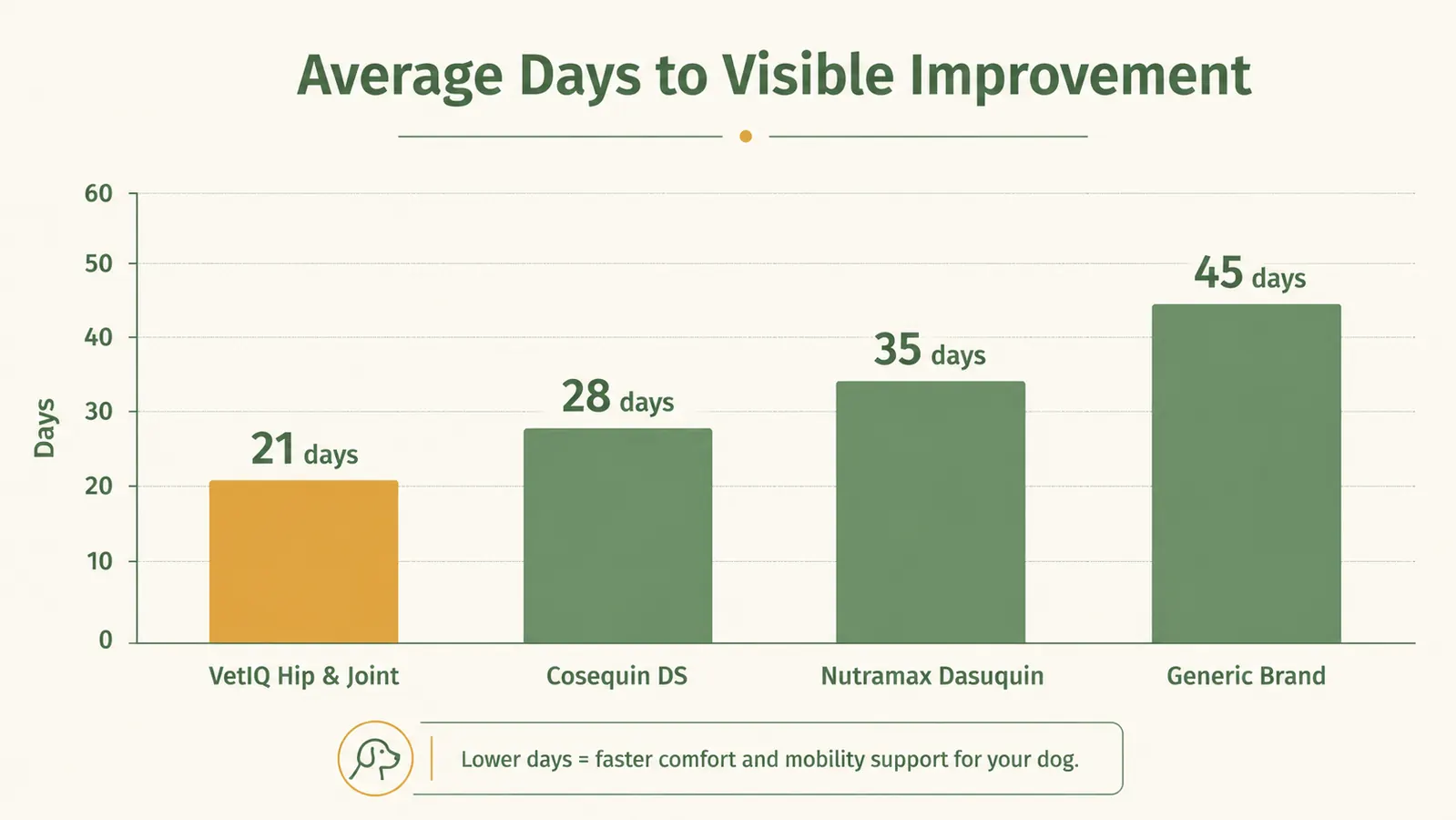
How VetIQ Stacks Up Against What I Tried Before
Before VetIQ I tried two other approaches. The first was a powder supplement mixed into Huckleberry's food. He picked around it for two days and then started leaving the entire meal. I got a bowl of glucosamine powder and a very suspicious dog. The second was a soft chew from a smaller DTC brand that cost considerably more per serving, was almost identical in active ingredient amounts per chew, but came in a smaller bag and used a salmon flavor that Huckleberry found more interesting than useful. He spent ten minutes inspecting the chew each time before eating it. Both were annoying in their own way.
If you are weighing VetIQ against Cosequin DS, which is the most commonly referenced over-the-counter joint supplement with veterinary endorsement history, the comparison comes down to chondroitin. Cosequin DS chewable tablets carry 500mg glucosamine and 400mg chondroitin per tablet. VetIQ at three chews delivers more glucosamine, 750mg, but only 60mg of chondroitin. If your vet specifically emphasized chondroitin sulfate as important for your dog's condition, Cosequin wins on that metric and it is not close. If you are managing early stiffness and want to start somewhere reasonable before committing to a pricier product, VetIQ is a defensible choice. I have a full side-by-side breakdown in my article on VetIQ vs Cosequin.
Palatability and Daily Practicalities
The VetIQ chews are the most reliably eaten supplement I have ever given Huckleberry. He eats them before I can set the bag down. That matters more than people give it credit for. A supplement your dog refuses to eat has zero efficacy. I have gone through the full range with him over the years: pills wrapped in cheese (he ate the cheese), capsules in peanut butter (he licked the peanut butter off and left the capsule), liquid mixed into food (suspicious from day one), and soft chews that got nosed around the bowl and eventually spit out onto the kitchen floor. VetIQ has been none of those things.
One 60-count bag at two chews per day lasts 30 days. At three chews it lasts 20 days, so your monthly bag count changes meaningfully depending on your dog's weight. For Huckleberry I go through about one and a half bags per month on the three-chew schedule, which keeps the per-day cost low. Subscription pricing on Amazon brings the cost down further and I have never had a bag go out of stock on a delivery cycle.
One frustration worth flagging: the product was listed as a 60-count bag when I ordered, but one shipment arrived as a 30-count bag at the same price. That was an Amazon inventory mislabeling issue, and a quick contact to customer service resolved it, but check the listing count carefully before assuming you are getting the larger bag.
What I Liked
- Huckleberry ate every single chew over three months without hesitation or delivery tricks
- Visible improvement in morning stiffness and stair confidence beginning around week five
- Glucosamine dose at three chews per day falls within standard vet-guidance ranges for a 28-pound dog
- One of the most affordable per-serving glucosamine chews with a real active ingredient profile rather than filler
- Over 29,000 Amazon reviews at a 4.6 star average, which is a large enough sample to trust the pattern
- No artificial colors and a clean readable ingredient list
Where It Falls Short
- Chondroitin dose at 60mg for three chews is well below what therapeutic-grade products carry; not a substitute for a clinical recommendation
- Liver smell is strong enough to be disruptive on an open kitchen counter; store in a sealed secondary container
- Resealable bag closure is weak and does not actually contain the odor after the first week
- Dogs over 50 pounds need four or more chews daily, which burns through bags quickly and erodes the budget advantage
- The 'vet recommended' claim on packaging has no disclosed study, survey, or veterinary board behind it
- No measurable effect for most dogs during the first three to four weeks, which is standard for glucosamine but still difficult to sit with when you are watching your dog struggle

Who This Is For
VetIQ Hip and Joint Chews are a solid fit for owners managing early-to-mild joint stiffness in small and medium dogs. If your dog weighs under 40 pounds, is showing the kinds of symptoms I saw with Huckleberry, a slight hesitation getting up from rest, less enthusiasm for stairs, slowing toward the end of walks, and your vet has said glucosamine is worth trying, this is a legitimate starting point at a price point that does not require betting on an expensive product before you know whether your dog will accept a chew format at all. It also suits owners who want a clean daily routine without managing capsules, powders, or liquid toppers. If you are not sure whether what you are seeing qualifies as joint trouble, I put together a list of 10 signs your dog may need joint support that can help you calibrate before you talk to your vet.
Who Should Skip It
Skip this if your dog is a large breed, over 60 pounds, with moderate or confirmed joint disease. The chondroitin dose is too low to align with what most veterinary rehabilitation protocols recommend for dogs with meaningful cartilage loss. You also need a lot of chews to reach a reasonable glucosamine level for a larger dog, which drives up per-day cost and removes most of the budget advantage. Skip it too if your vet has given you a specific product recommendation with dosing rationale behind it. That recommendation is there for a reason and VetIQ is not a clinical-grade product. It is a maintenance supplement, and honest marketing would say that more plainly than the label currently does.
Three months in, I am still refilling this bag. That is the most honest endorsement I can give.
VetIQ Hip and Joint Soft Chews have made a real difference for Huckleberry's morning stiffness and stair confidence. Check today's price to see if it makes sense for your dog before committing to a higher-cost option.
Amazon Check Today's Price on Amazon →